Under the short-gradient pulse (SGP) approximation, the pulsed-gradient spin-echo (PGSE) diffusion NMR signal from a restricted population of spins as a function of b-value or wavenumber q or gradient strength |G| shows a characteristic diffraction pattern (Callaghan Nature 1990). Moreover, the frequency of the diffraction pattern varies inversely with the size of the restricting pore, so the diffraction pattern provides an elegant estimation of the pore size. In practical experiments, however, the short-gradient pulse assumption is usually violated, because finite pulses are necessary to get sufficient diffusion weighting. As the pulse length increases, the true signal rapidly departs from that predicted under the SGP approximation.
The Gaussian Phase Distribution (GPD) approximation (Murday JCP 1968; Neuman JCP 1974) provides a better approximation to the signal under some conditions, but does not show the characteristic diffraction pattern. Under what conditions does the approximation fail? Does the lack of diffraction mean the approximation is no use when estimating pore sizes?
This note compares GPD approximations of the signal from spins trapped inside cylinders with the corresponding signals estimated using Monte-Carlo simulation (Hall TMI 2009). Results suggest that the lack of diffraction is not the most significant inaccuracy of the GPD approximation. They further suggest however that the diffraction pattern is not the most sensitive part of the signal to pore size and that the lower b region is more important. Overall, the inaccuracy of the approximation does not appear to have a significant effect on pore-size estimates.
We estimate the diffusion NMR signal from spins diffusing within an impermeable cylinder with each combination of the following PGSE-parameter settings (using Matlab array notation):
\delta = 0.5, 1:1:10 ms
\Delta = max(\delta,1):1:10, 20:10:100 ms
G = 20:20:1000 mT/m
In the Monte-Carlo simulation, we obtain a synthetic measurement for each of 8 different gradient directions equally spaced in the plane perpendicular to the cylinder axis. The simulation uses 160,000 walkers and 5000 timesteps. The free diffusivity is 4.5E-10 s/m^2. The eight measurements with the same PGSE parameters but different direction should be the same, so their variance provides a measure of the uncertainty in the synthetic measurements. We repeat the simulation for each cylinder radius R in {1, 2, 5, 10} microns. The highest variances within the groups of 8 occur for R=5 microns when the mean standard deviation is 0.0008 and the maximum standard deviation is 0.0033 (at \delta = 5 ms, \Delta = 40 ms and |G| = 1 T/m) with the signals normalized to 1 at b=0.
The top row of figure 1 (click on the image, then click on it again to see it full size) plots all the synthetic data from the Monte-Carlo simulations to give a feel for the full data set. The bottom row of figure 1 shows the equivalent signals predicted by the GPD approximation. The two approximations provide similar signals at low R, but differences are apparent for the larger radii. In particular, the diffraction patterns are clear in the Monte-Carlo signals, but absent in the GPD approximation. The differences appear dramatic on the log-scale plots in figure 1. However, plotting on a linear scale reveals that the differences are less significant than at first sight. Figure 2 compares signals from the two approximations for R=5 microns only using the same markers and colour scale as figure 1. The signals from the two approximations are hard to distinguish in figure 2, because the diffraction patterns occur mostly in the signal range 0 to 0.05. In practice signals in that range are often insignificant, because they are indistinguishable from noise, which is additive in NMR experiments. Moreover, considering figure 1 again, it is clear that the part of the signal that is most sensitive to changes in cylinder radius is not the diffraction pattern, but the rate of attenuation as |G| increases.
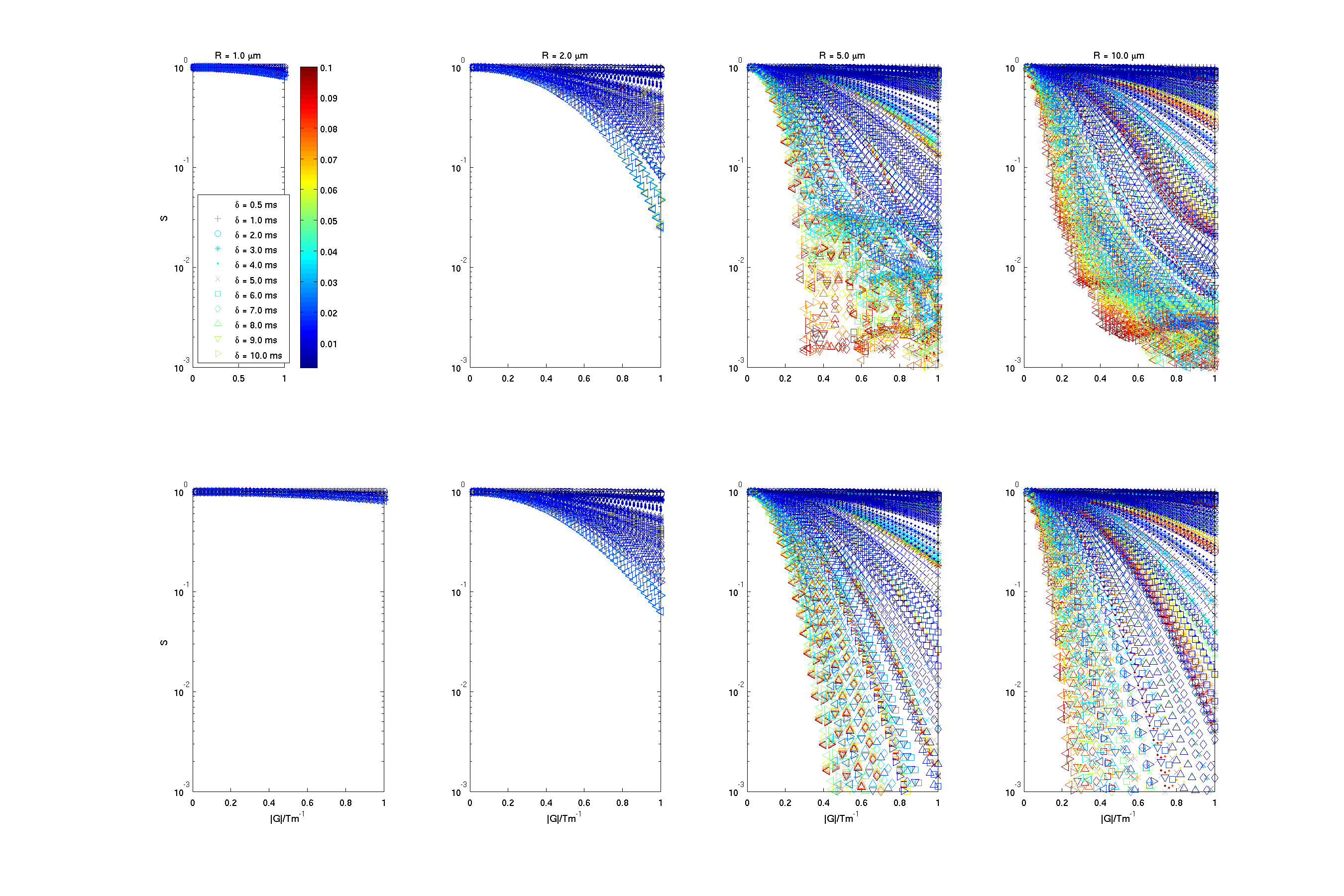
Figure 1. Plots synthetic signals against gradient strength for each combination of \delta and \Delta. The marker distinguishes the different settings of \delta, as the legend shows, and the colour indicates \Delta, as the colour bar shows. From left to right the signals come from spins inside cylinders with radii 1, 2, 5 and 10 microns. The top row shows the signals from the Monte-Carlo simulation and the bottom row shows the signal from the GPD approximation. Click on the image and then click on it again to see it full size.
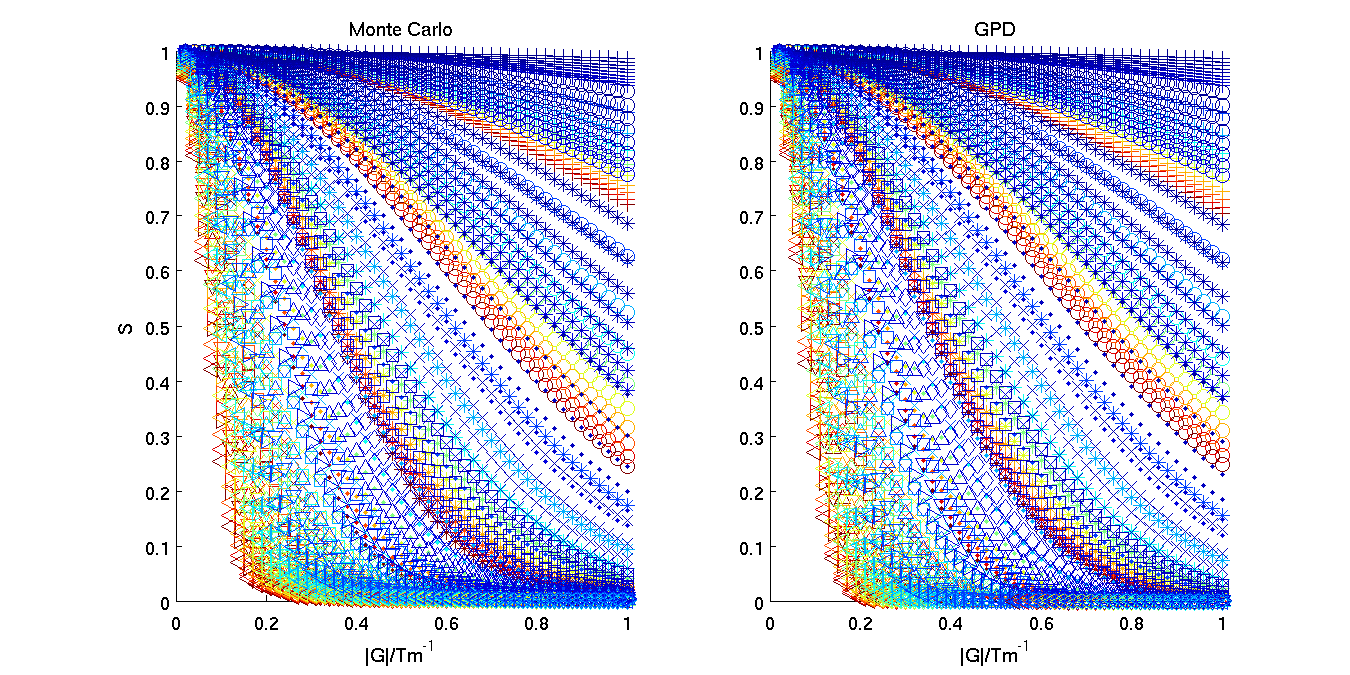
Figure 2. Plots of synthetic signals on a linear scale for just one radius. Left: Monte Carlo. Right: GPD. Legend and colour scale are as figure 1.
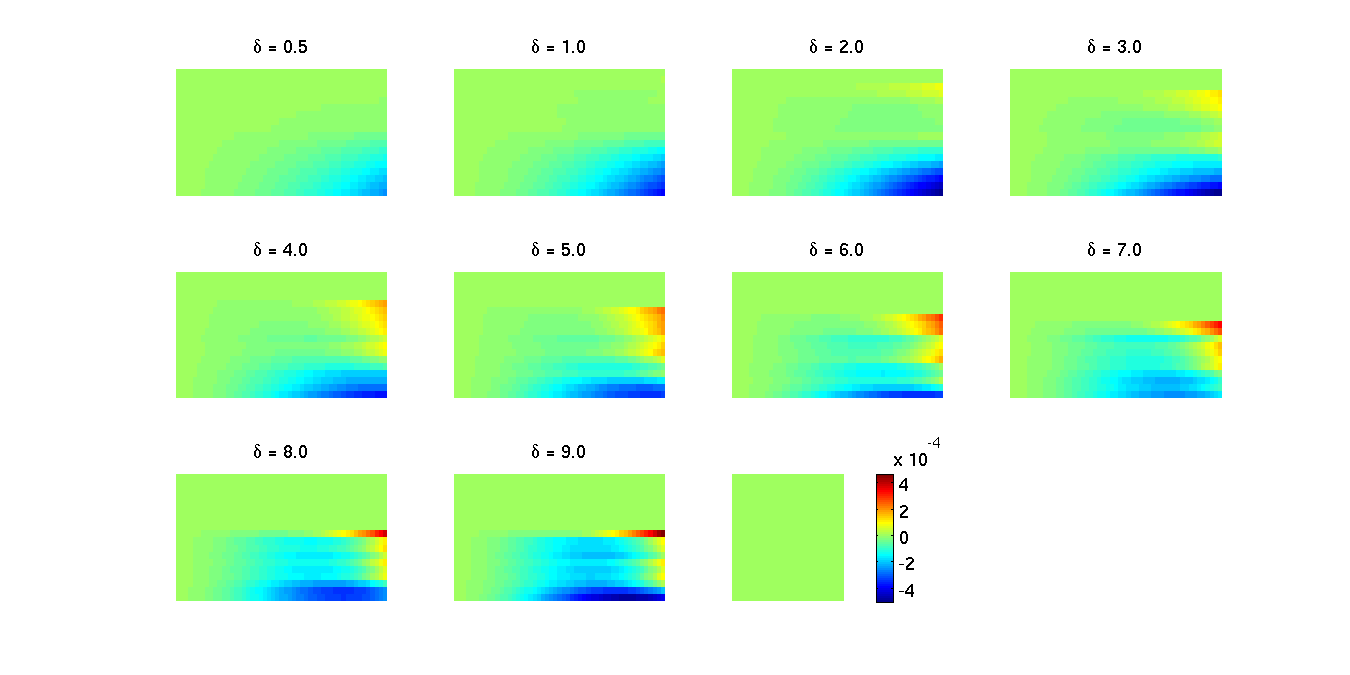
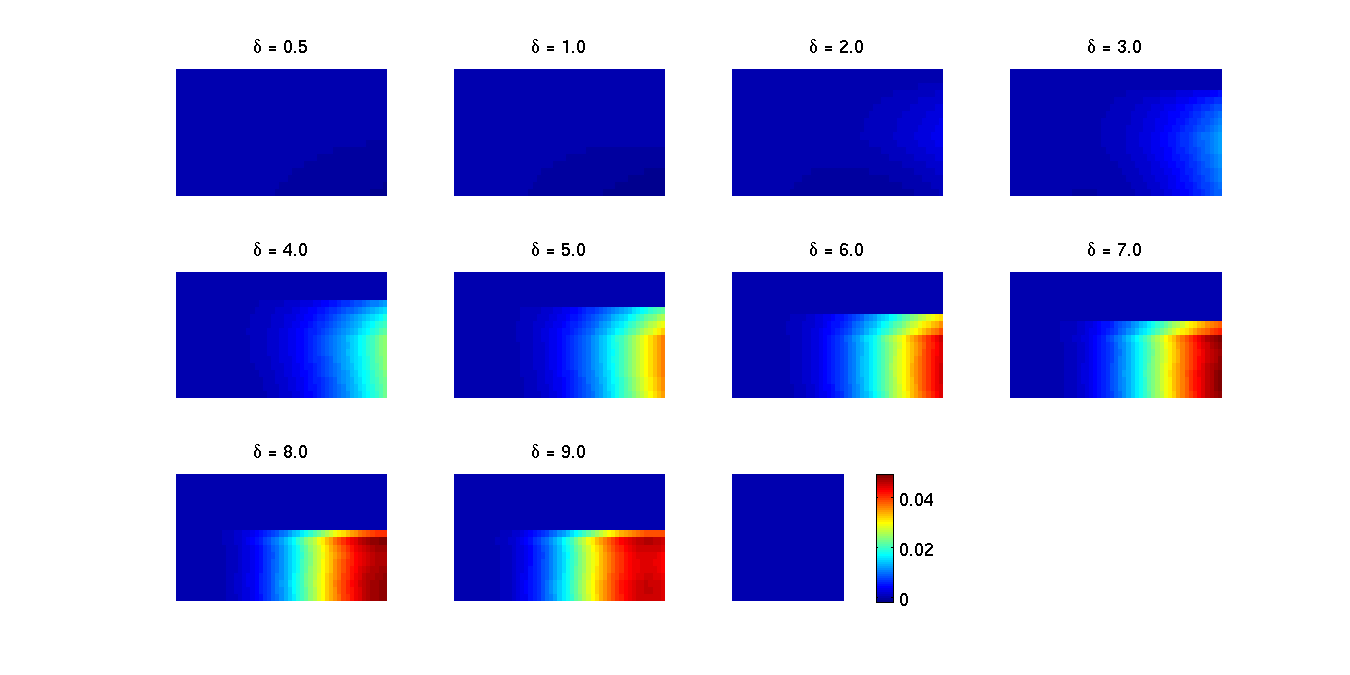
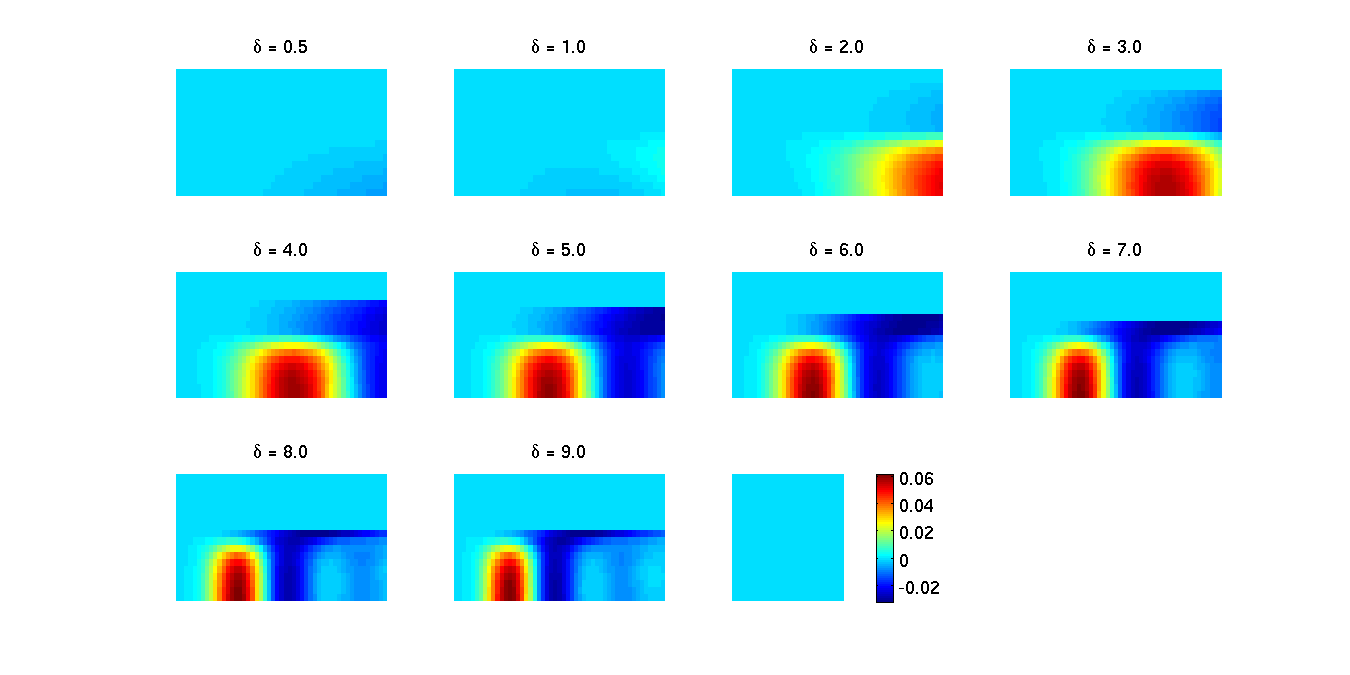
Figure 3 plots the difference between the two approximations to the signal. The differences are very small for low R, but increase to a maximum at R=5 microns where they reach a maximum difference of around 0.06, ie six percent of the unweighted signal, which could be significant. At higher R the size of the difference decreases again.
(a)
(b)
(c)
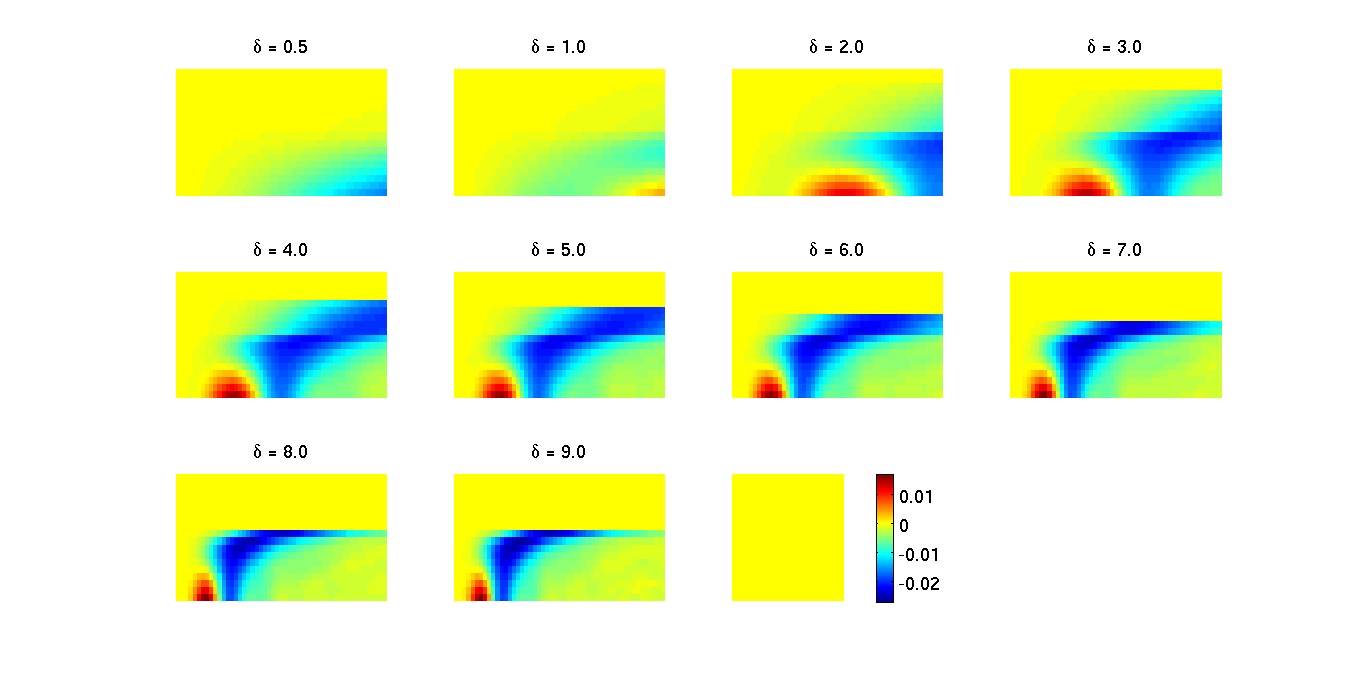
..................................................................... (d)............................................................... Figure 3. Plots of the difference between the GPD signal and the Monte-Carlo signal for each cylinder radius. Panel (a) R=1; (b) R=2; (c) R=5 and (d) R=10 micron. Each plot contains a subfigure for each \delta. The subplots map the error for each combination of |G| on the x-axis (increasing left to right) and \Delta on the y-axis (increasing top to bottom).
To give an example illustration of where the most significant errors occur, figure 4 plots both signal estimates together on a log scale (left) and linear scale (right) for R=5 micron and \delta = 5ms. The plot highlights in red all the measurements where the difference between the two approximations is greater than 0.02. The plot shows clearly that the largest differences are not in the diffraction region of the signal.
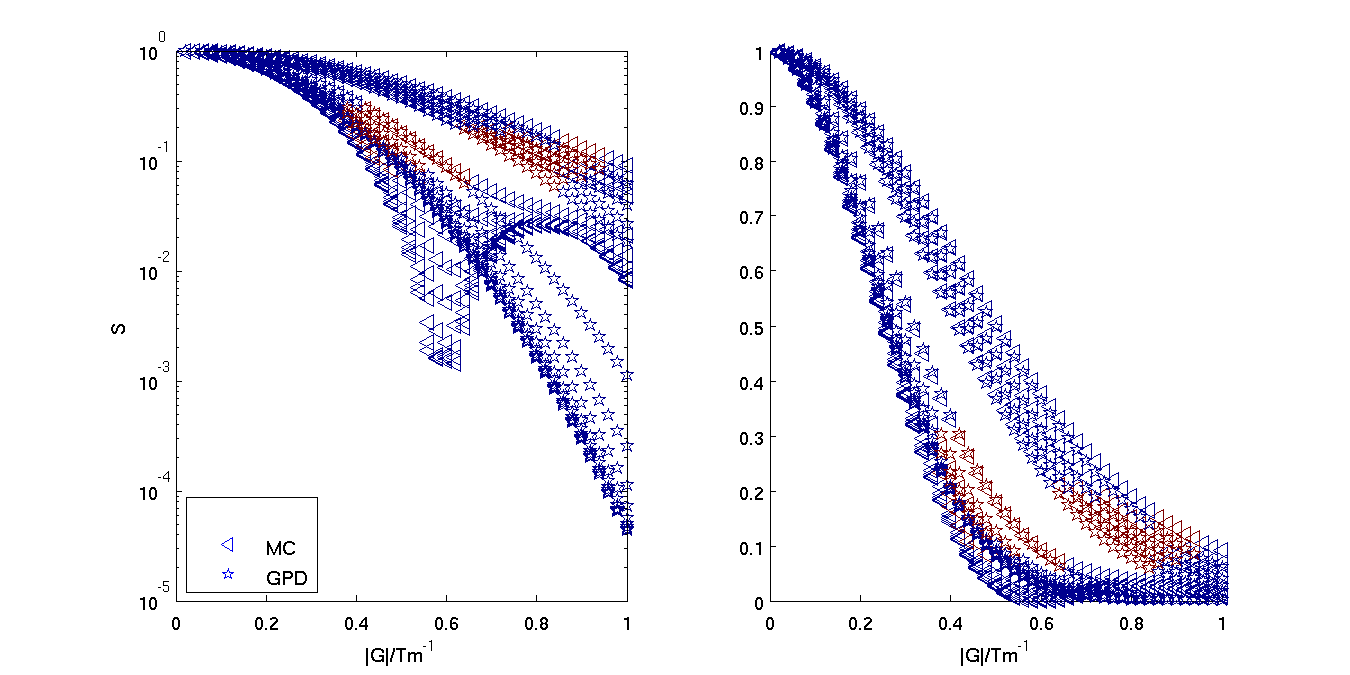
Figure 4. Plots the signal from both approximations together for R=5 micron and \delta = 5ms. The data are the same in both figures, but the left plot shows the log scale and the right plot the linear scale. Red markers show where the difference between the two estimates of the same signal differ by more than 0.02; blue where the difference is less.
So do the departures between the two approximations make any difference to estimates of pore size? Taking the Monte-Carlo data as ground truth, we can evaluate the effect of assuming the GPD approximation when fitting for the cylinder size. To examine the worst-case scenario, we identify for each R just the ten percent of measurements that have the largest differences between the two approximations. We estimate the cylinder radius by fitting the GPD
model to the Monte-Carlo signals for those measurements only. For true cylinder radius of 1 micron, the estimate is 0.99994 micron when the diffusivity is fixed to the true value of 4.5E-10m^2/s and 0.99937 micron when we fit for both the diffusivity and radius simultaneously. When the true cylinder radius is 2 micron, the two estimates are 1.99999 and 2.00000 micron. When the true radius is 5 micron, they are 4.9508 and 4.9627 micron. When the true radius is 10 micron, they
are 9.5175 and 7.1275 micron. Thus, although the error does increase as R becomes larger, the error in the GPD approximation does not appear to have a major effect on the best estimate of the pore size.
Here is the data and the schemefile in case anyone wants it.
It’d be interesting to see how the GPD approximation would cope when multiple radii are present. With multiple radii the diffraction pattern becomes far more difficult to interpret but the GPD might still be tractable.